
Our Technology Became Quantum. Our Mindset Remained Industrial.
Why the future of productivity requires ancient wisdom, stillness, and a new way of creating.

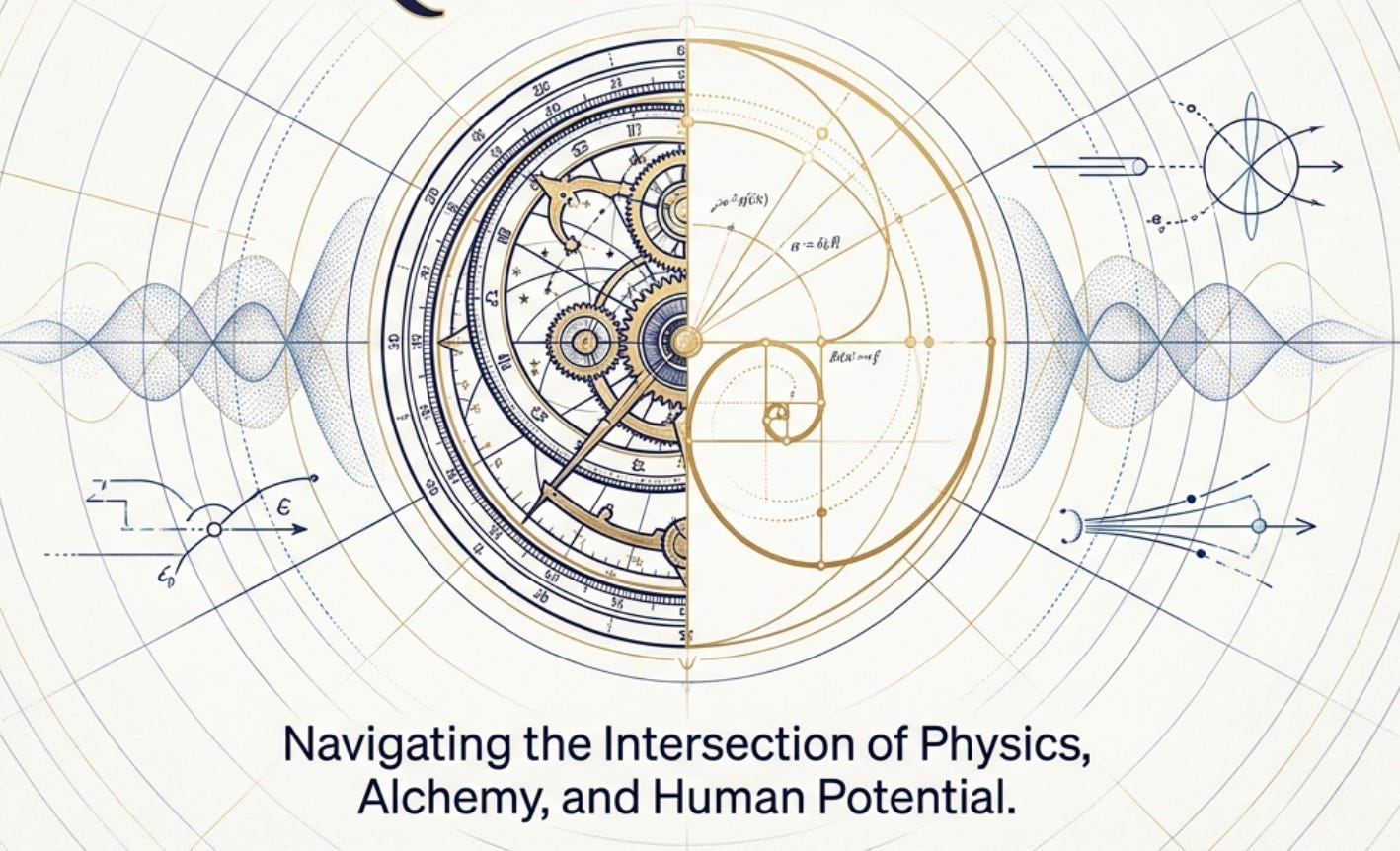
To understand why so many of us feel overwhelmed today, we need to zoom out.
Much further out.
Because the story of modern productivity is actually the story of how humanity has understood reality itself.
The Evolution of How We Understand Reality
11,000+ Years Ago: The Ancient World
Science and Spirit Were One
Ancient civilizations viewed the universe as a living, interconnected system. Astronomy, mathematics, healing, philosophy, and spirituality were not separate disciplines but different ways of understanding the same reality. Human beings saw themselves as participants in nature rather than observers standing apart from it.
Mindset: Interconnection
The question was not, “How do I control life?”
The question was, “How do I live in harmony with it?”
Before 1600: The Age of Alchemy
The Original Scientists Were Mystics
Alchemy was the precursor to modern science. Alchemists studied nature, matter, consciousness, and transformation. Their goal was not only to understand the laws of the universe but also to transform themselves. Inner development and scientific inquiry were considered inseparable pursuits.
Mindset: Transformation
To an alchemist, the laboratory and the soul were connected. Understanding nature required understanding oneself.
1687: Newton and the Scientific Revolution
The Great Separation Begins
When Isaac Newton published Principia Mathematica in 1687, he provided a mathematical framework for understanding the physical universe. Ironically, Newton spent much of his life studying alchemy and theology, yet history largely remembers only his physics.
For practical and political reasons, science and spirituality began to separate. Scientists focused on the material world while spiritual questions were left to religion.
Mindset: Predictability
The universe increasingly came to be viewed as a machine.
1750–1900: The Industrial Revolution
The Rise of the Machine World
Newtonian thinking fueled extraordinary technological progress. Factories, engineering, industrial systems, and mass production transformed society.
The same mindset eventually shaped education, business, and productivity.
Efficiency became the highest virtue.
Output became the measure of value.
Human beings increasingly began treating themselves like machines.
Mindset: Optimization
Work harder. Move faster. Produce more.
1900–1927: The Quantum Revolution
Reality Gets Strange
Just as scientists thought they had nearly figured everything out, quantum physics arrived and overturned many of their assumptions.
Einstein, Planck, Bohr, Heisenberg, and Schrödinger discovered a reality far stranger than classical physics could explain.
The observer mattered. Potential mattered.
Uncertainty was built into the fabric of reality.
Reality appeared less like a machine and more like a field of possibilities.
Mindset: Possibility
1927–2020: One Hundred Years of Testing
Science Verifies the Impossible
For nearly a century, scientists tested the predictions of quantum physics.
Again and again, experiments confirmed phenomena such as entanglement, probability fields, and non-local connections that challenged the old worldview.
Yet something interesting happened.
Science evolved. Technology evolved.
Technology evolved.
We continued to organize our schools, workplaces, economies, and lives according to industrial-age assumptions.
2020–Present: The Age of Recombination
Bringing Wisdom Back Into Science
Today we possess more information, more technology, and more power than any generation before us.
Yet anxiety, burnout, distraction, and overwhelm continue to rise.
The challenge is no longer a lack of knowledge.
The challenge is a lack of wisdom.
We are entering what Dr. Theresa Bullard calls an age of recombination, a period in which science, consciousness, ancient wisdom, and spirituality can begin working together again.
Not to replace science or reject reason.
But to create a more complete understanding of what it means to be human.
And perhaps the most important realization is this:
Our technology became quantum. Our mindset remained industrial.
I see this every day in my coaching practice.
Most productivity systems were designed during the Newtonian and Industrial ages.
Create plans, set goals, know your intentions, focus, have a system in place and I see value on all of these tools.
And while these tools still have value, and I love them, I see a need of going to places beyond planning.
There is no productivity app that can tell you what your soul is asking of you next.
This is where a quantum perspective becomes practical.
Quantum physics reminds us that uncertainty is not a problem to solve.
It is the space where possibility exists.
The unknown is full.
It contains futures that have not yet been chosen.
Mindfulness helps us step out of reaction and into observation. It allows us to pause long enough to access what Dr. Therese Bullard calls the “zero point”, a state beyond assumptions, expectations, and fear.
A place where new possibilities can emerge. A place where inspiration can arrive. A place where we stop forcing answers and begin receiving them.
From this place of stillness and clarity, planning becomes useful again. This is where I believe modern productivity has been missing a crucial step. We often try to plan before we listen. We try to execute before we become clear. We try to optimize before we truly understand what matters.
The future of productivity is not about abandoning structure, discipline, or action. It is about integrating structure with wisdom. It is about creating space for awareness before moving into action, so our plans are not just efficient but aligned.The future of productivity is the integration of seemingly opposite forces: stillness with action, intuition with planning, ancient wisdom with modern science. It begins by entering the quantum space, the space of stillness, awareness, and possibility. A place where we can slow down enough to listen, observe, and allow new insights to emerge.
Then, we return to the Newtonian world, the world of action, structure, and execution. We take what we received in stillness and turn it into something tangible. We build the plan. We create the structure. We take the next step.
That, to me, is modern alchemy: the transformation of information into wisdom, the transformation of effort into intention, and ultimately, the transformation of a busy life into a meaningful one.
And perhaps the greatest productivity skill of the future will not be learning how to do more.
It will be learning how to slow down long enough to hear what wants to emerge next.
This is essay was inspired by interview with Dr. Therese Bullard